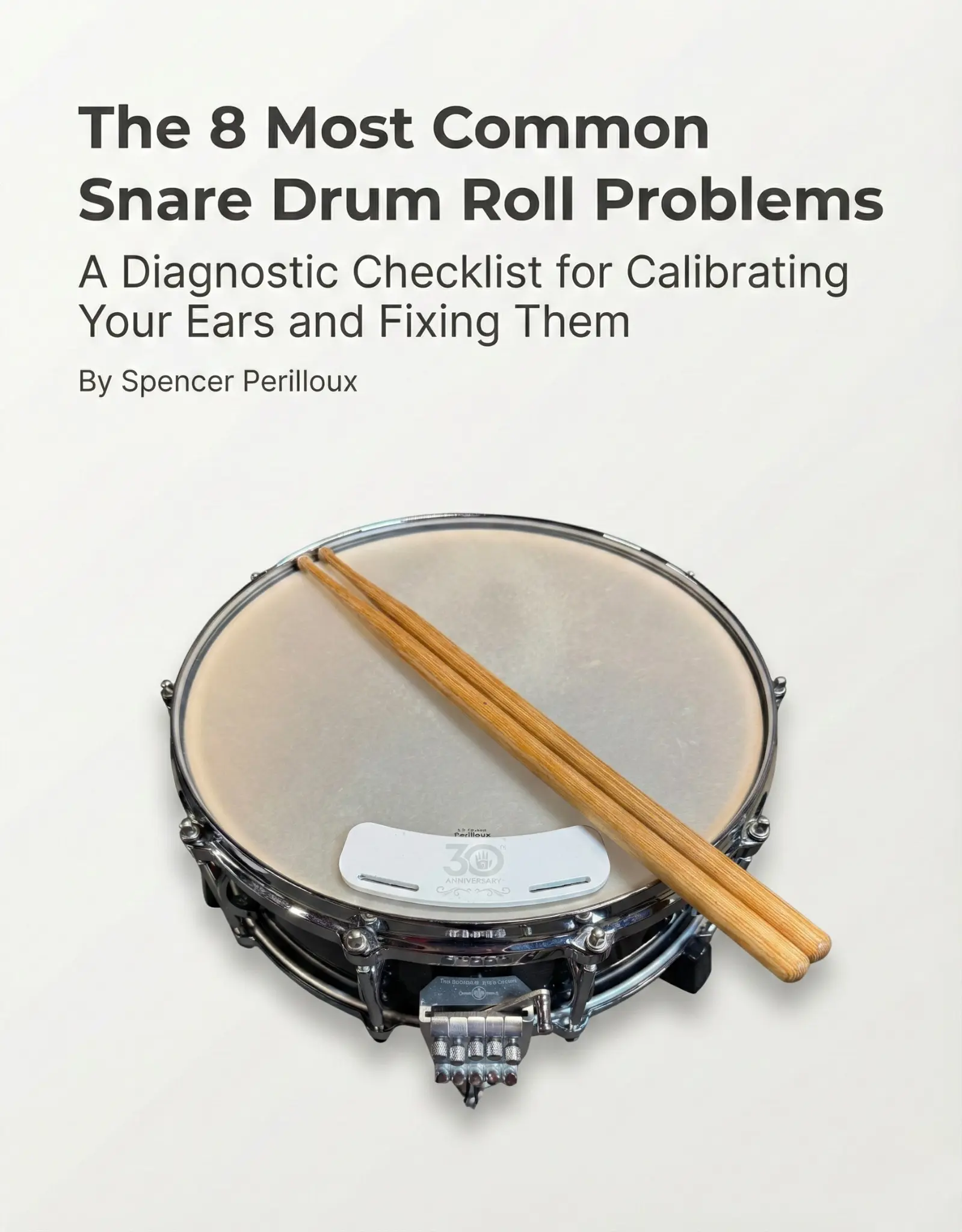
The 8 Most Common Snare Drum Roll Problems
A practical diagnostic checklist for identifying exactly why your roll isn't working — and what to fix first.
Most Roll Issues Persist Because You Don't Know What Variable Is Actually Wrong
Your roll might be failing because of speed, density, stick height, or beating spot. Vague advice like "relax," "roll faster," or "more buzz" doesn't solve diagnostic problems.
You need a system for identifying the exact variable that's failing—and this checklist gives you that system.
What This Is
- A diagnostic reference for the practice room
- A decision tool for identifying what's actually wrong
- A way to calibrate your ear using controlled extremes
What This Is Not
- Not a beginner method book
- Not a repertoire collection
- Not video instruction or demonstrations
What's Inside
The Roll Base Guide
Tempo × dynamic table showing exactly how fast to roll at any tempo and dynamic level
Four Roll Variables Framework
Speed, density, stick height, and beating spot—how they interact across dynamics
8 Symptom-Based Diagnostic Entries
"My roll sounds choppy," "My forte roll falls apart," etc.—go straight to your problem
Too Little / Too Much / The Middle
Ear-training approach that calibrates your judgment by exploring extremes
One-Page Mental Decision Tree
Quick reference for diagnosing any roll problem in seconds
14 Pages Total
Concise, text-only format designed for quick reference—not binge reading
Who This Is For
- High school and college percussionists
- Adult and community band players
- Anyone who "has a roll" but doesn't trust it under pressure
Who This Is Not For
- Absolute beginners who haven't learned a basic roll yet
- Players looking for a comprehensive method book
- People expecting video demonstrations or audio examples
About the Author
Spencer Perilloux is an orchestral percussionist and educator with performance experience across six professional orchestras. He holds a Master of Music from the University of Michigan and a Bachelor of Music from Central Michigan University.
His teaching philosophy centers on diagnostic-first problem solving: identifying the exact variable that's failing before prescribing a solution. This checklist reflects that approach—no vague advice, just clear reference points for calibrating your ear and making confident adjustments.
Spencer's systems are designed to be predictable and repeatable, giving players the tools to diagnose their own playing without relying on guesswork or trial-and-error.
A single private lesson costs $50+. This guide gives you the diagnostic tools of a professional lesson for less than the cost of a new pair of sticks.
Download the Checklist
Immediate PDF download. Practical reference designed to be revisited, not binge-read.
One-time purchase • Instant access • 14-page PDF
Secure checkout powered by Stripe